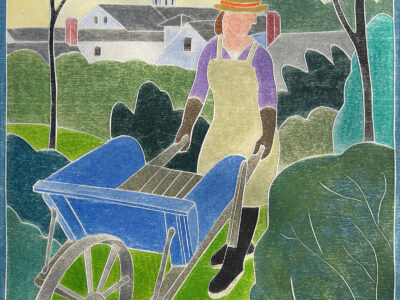
Schoodic Inlet, 1967, pastel, 16 x 23
Arthur Thompson
bio
chronology
press
Arthur Albert Thompson (1907-1988), twentieth century artist, was born in Boston in 1907. Both of his parents were pharmacists. Thompson studied functional design at Harvard Architectural School and MIT as an alternative to formal painting instruction. He had always drawn freehand with facility and compassion.
During the Great Depression, participation in the WPA Art Project allowed him time and space to explore work of the Alfred Stieglitz group and the newly organized American Bauhaus. As early as 1940, Stieglitz showed Thompson’s watercolors to an intimate audience and presented him with a small purse for continuity.
In 1947, with Rosamond and their daughter Jane, he moved to Sorrento, a small village in downeast Maine. A recurring need to put bread on the table resulted in a fifteen year schism between art and salaried architecture. The Thompsons opened “185 Art Gallery” in Sorrento to house bold and outrageous crayon drawings. A 1963-64 appointment to the teaching staff of Penn State University was almost the last interruption in his career. Thompson returned to the Maine Coast, excited with new color theories, and a determination “to retire.” His works of the 70’s and 80’s are quietly energetic, so naturally muralesque as if art and architecture are contained in a single frame.
Arthur Thompson has had multi-shows at the U of M in Orono and at other Maine colleges and galleries. He has exhibited in the Santa Fe Museum; Kalamazoo Art Gallery, Michigan; Penn State College; and the Beckett Gallery, Hamilton, Ontario. In his native Boston, he showed at the Grace Horne Gallery, Margaret Brown Gallery, the New Gallery. Other exhibitions in Massachusetts were presented at the Rockport Art Association, the Helen Bumpus Gallery, the Contemporary Gallery, and Provincetown Art Association. More recently, his works have been shown at the Gleason Fine Art Gallery in Boothbay Harbor, the College of the Atlantic in Bar Harbor, the Shaw Gallery in Northeast Harbor, the O’Farrell Gallery in Brunswick, The Clown Gallery and Cooper Jackson Gallery in Portland.
Arthur Thompson (1907-1988)
12/1/07 - 12/18/88
May 14, 2008
By Jane Sumner
Of the overlapping generation of painters who died between the mid-1960s and 80s, there are only a handful with strong Maine affiliations and whose names are easily recognizable to us today. They include Fairfield Porter, Carl Sprinchorn, Karl Schrag, Stephen Etnier, Andrew Winter, and William Kienbusch. We also remember William Zorach and Bernard Langlais, who were best known as sculptors, but were also fine painters. And, of course, there is Andrew Wyeth, who died recently. Each artist made a deep commitment to interpreting the Maine landscape in his own style.
Arthur Thompson unquestionably belongs in this special brotherhood. I have known his work for well over a quarter century. Of all the artists mentioned above, Thompson was one of the most committed to Maine, as he spent four decades of his life living and working Down East.
As Thompson’s style matured, he worked primarily in the medium of oil pastel. He outgrew his earlier influences and honed his skill by interpreting the essence of Maine in both the coastal and inland areas. He was also influenced by the artists that were mentioned above.
He was a Modernist who found his voice in a style similar to Marsden Hartley’s later work.(1) In his early watercolors, we see his debt to John Marin. His mature oil pastels, have a substantial affinity for Hartley’s work (2); though I doubt Hartley will come to mind unless one takes the time to get to know Arthur Thompson better.
I own some of his oil pastels and I never tire of looking at them. He was an artist with strong sensibilities who merits more of our attention.
Chris Huntington
[read more]
"I have been into 'art' for several decades and have participated in most of the phases and styles now known as realism, abstractionism, non-objectivism, multi-views etc. Throughout twentieth century influences, my interest repeatedly surfaced on the art of drawing with nature, using pastel and crayon strokes to record the instant changes, movements, and differentiation of living things, with minimal hesitation between a colored chalk and a record on paper. Ultimately, I am formalizing this record by a process of designs made out-of-doors, no doubt an influence of many years spent in architectural studies."
1907
December one, Arthur Albert Thompson is born in Boston, Massachusetts. His parents, Dr. Leon A. Thompson and Jennie E. Lincoln, were educators and practitioners in the field of pharmacy.
The Thompson Apothecary was located in Brookline, where early schooling was in public education. The family lived in a three-story apartment building with whitewashed back fence where a child's graffito could be seen for miles. "I always drew something, even on brick walls. I was introduced to broken color in the sixth grade." -- Of his first heroic sized mural, "I have drawn on my own since I can remember, from the 4th grade on -- when I drew a Santa Claus on the blackboard in colored chalk."
The family moves to a brown clapboard house on Granite Street, Cambridge. A bout with scarlet fever prompts Dr. Thompson to sell both drugstores and return to teaching pharmacy. Granite Street was a landmark dwelling with recessed front yard and walk between two catalpa trees, a sort of haven where in later years an artist might look out of the window and draw a jumble of roofs, city smoke, railroad tracks and beyond.
When Mother decides to study pharmacy, Grandmother Lincoln looks after Arthur and his older sister, Ruth. At Cambridge High & Latin, he is chosen to be editor of the yearbook and periodicals. "I made drawings of uncalled-for social comment." A course in high school architecture was taught by Miss Willoughby, a recent graduate of M.I.T. "So I got into architectural drawing with afterschool sessions in student portraiture, still life and cast drawing — With all this, I would look wonderingly at the arcs and verticals and horizontals that I could see in the freehand room next door." Miss Willoughby and the freehand drawing teacher were doors apart.
1925 - 28
After graduation, father and son visit Parker, Thomas and Rice in Boston. The duties of an office boy are to render classical ornament in India ink on now famous landmarks -- The Boston Gas Co., John Hancock Building, United Shoe Machinery, "...their last building, the decor for which was taken out of Raguenet's Book. . . .A more eclectic concern -- or more successful -- never existed." (How do you like your new job, Arthur?) "I remember the twigs -- in the seventh grade I discover the structure of twigs and leaves and make microscopic studies -- very haptic -- no background."
Far into the night, wee hours are spent with other aspirants at the Boston Architectural Center developing "the orders" Beaux Arts Style with Massiere Arcangelo Cascieri, wood carver by day, critic by night. There is life class with Boston artists. There are projects such as decorating the Great Hall where architects and engineers quarrel over "beauty -- no less." Thompson's idealized projects win first medals and honors. He would return in later years to help others achieve a different standard of excellence. For now, the system frowned on anything "charetty" or unfinished.
Painting lessons with John Wharf, Boston artist, continue for several years. The early influence of dimensional realism will last a lifetime and appear sporadically as a link with the past.
1929
Off to places that stir the imagination. Arthur sails around the world aboard the passenger ship S. S. PRESIDENT HARRISON as a member of the crew. Assists the navigation officer in "the tower," visits cities in the East and Near-East, embarks in New York City and returns to Cambridge in the family vehicle.
1930 - 32
An obedient pencil wins a two year scholarship to Harvard University. "At Harvard, the thing that was true to me was the struggle for an expression called design -- the elements of which seemed to have been laid in seven parts (Seven Lamps of Architecture) and buried in the tomb of Napoleon."
He was never tuned to the symmetry of Beaux Arts' last hurrah. "I remember struggling with a plan and working it out asymmetrically although not being conscious of asymmetry yet as an aesthetic -- and while struggling, Mr. Haffner coming along -- and making those puffing noises and saying what a mess, and then neatly arranging the thing on two sides of an axis so that it balanced perfectly but somehow didn't work for me."
An exhibit of watercolors at the Boston Architectural Center and an uncapitalistic response to hanging art in public places on Beacon Hill. "I had to buy back my picture after it [Capitoline Gardens Restaurant] folded up."
1933 - 34
A short span of working in architecture at Stone & Webster Co., followed by a memorial competition for Isadore Richmond. A scholarship to M.I.T. and a walk through Doric columns to the brand new world of German Bauhaus Architecture. Under the banner of "form follows function" the dragon "Ornament" has been slain and there will be harmony between architects and engineers. It is an agreeable climate and there is life drawing from live models.
Three entries and three competitions later, at the end of the school year, Thompson loses the Rotch Traveling Scholarship to Bunshaft, who seldom agonized over plan solutions. Second prize is no consolation. It was whispered that he swallowed up time, almost down to the wire, changing and discarding all previous thinking, until the final presentation was hastily rendered. Persuasive powers will not convince Thompson to work for a fourth attempt. He disappears and cannot be reached for the F. W. Chandler Prize #1 presented by Dean Emerson at the graduation dinner.
1935
The Great Depression is in full swing. Arthur and other misplaced Architects seek refuge in the Boylston Street establishment of Jones, McDuffey & Stratton Co. It is temporary relief at best, but A. Thompson and J. Barr, Jr. design blue centennial dinner plates and dream on. An Architect's Ball in the Great Hall and a chance meeting with artist Rosamond Hilton Grant, student at the Boston Museum School. She cares little for his realistic watercolors, less for his complicated palate, but their common miseries grow into a lasting friendship. Arthur joins the W.P.A. Public Works Project and transfers to the Art Project, a highly organized government program which offers freedom of expression at the price of turning in one's work on a monthly basis.
1936
A period of study and emulation. Liberated by the Marin watercolors, Arthur paints delicate pink factories and pristine gas tanks of his own industrial city. Takes six giant steps to the Grace Horne Gallery, Boston. "You're fifty years ahead of the City of Boston," said Director Gayton Whitemore, whose promise of a one-man show never materialized after his sudden demise.
Arthur, Rosamond and their new daughter Jane move their homemade Bauhaus furniture from an apartment in Brookline to an Art Colony in Rockport, Massachusetts.
1937
A stimulating summer, a harsh New England winter, the following summer ends with a migratory move to Harvard Square and a near split with the W.P.A. over an unplanned reversal in painting style. On leave of absence to visit the Thompson homestead in John Marin's Maine, Arthur spends precious hours studying the work of Rudolph Bauer. Begins a sequence of four "futuristic" oil paintings in symphonic sequence. A rectangular brown and yellow canvas with interlocking amorphic shapes is unacceptable to staid Back Bay. A caption in the Boston Newspaper linking Thompson with Braque and Tanguey as proponents of "insane art" at the New Gallery on Newbury Street is flattering.
1938 - 39
Thompson hangs the first non-objective painting in the Rockport Art Association summer show without incident. The search for shapes in the mind continues. Students visit the Contemporary Gallery in Rockport to surround Arthur's abstract "Apple Tree in Blue Crayon." Arthur quits the W.P.A. and travels to New Mexico.
1940
At the Santa Fe Art Museum, a one-man show of earlier landscapes and new transitional watercolors of New Mexico. Swift brushstrokes at vague intervals suggest the spaciousness of the Country but critics prefer the green grass of New England and try to equate the newer with something familiar.
1941 - 43
Arthur meets Alfred Stieglitz at "291" New York City. The aging photographer, wrapped in his black cape, strolls the city block, stops for an ice-cream cone, buys one for the "boy who is trying to paint" and talks tirelessly about Marin and how "The Place" doesn't go far enough. Stieglitz frames five watercolors and introduces Arthur to his intimate group of artists. Arthur returns home and empties out the contents of a small purse from Stieglitz on the kitchen counter. The summer is one of high productivity. Rosamond transfers her energies from a typewriter in a Boston law office to a portable L. S. Smith on the dining room table.
Remembering his own successful publication "Camera Work," the proceeds from which supported Marin, O'Keefe and others, Stieglitz had earlier suggested pamphlet writing as a solution to the artist's dilemma. The Thompsons collected their writing and drawing to make four handmade editions of thirty copies each. (The final issue of "As We See" was set in linotype hired from a printer's office.) With limited funds for painting materials, simple pencil movements of ducks diving on the Charles River, done out of necessity, gain in complexity, become rhythmical, energetic expressions in black and white. Rosamond and Arthur work in electronic drafting and radar production at Raytheon Co.
1944
A joint exhibition of Drawings and Paintings by Thompson with Wood Sculpture by Cascieri in Robinson Hall, Harvard University. "This work has been developed during the building depression of the last ten years -- it is architectural, an expression of continual effort to make something good in a given medium."
1945 - 47
"During the war, I worked in various offices and government agencies, including two years at Dewey & Almy Chemical Co. Carl Richmond went with Walter Bogner and asked me to work with him. I did until 1947. That year, my mother died and I came to Maine to live with my father."1948 - 50
"A series of multi-view crayon drawings and paintings of the village where I live."
1951 - 52
The struggle to support his art never ceases. As designer in the Architectural Office of Eaton W. Tarbell & Assoc., he drives ninety miles each day to work on some of the largest buildings in the region: the Bangor Auditorium, Bangor High School, schools in Dexter, Danforth, Rockland, and Hamden, Limestone Air Force Buildings, Osteopathic Hospital, -- the list is endless. He always remembered where he left his crayons and an exhibition of drawings and paintings at the Bangor Public Library surprises and delights a small audience.
1953 - 56
Fifteen years with the Tarbell Assoc. are not consecutive. Arthur works four years with George Savage in Northeast Harbor on alterations for David Rockefeller House, Parks and Buildings for Rockefeller, Sr., Lippincot House, Langhorn House, houses in New Hampshire and Rhode Island. Odd hours and brown bag lunches are for sketching blue inlets, pink mountains and swirling clouds on Mount Desert Island.
Paintings in the Pusey Summer House, drawings for Mrs. Henry Ford III, S. E. Strout, G. S. Marvel and others are purchases through George Savage whose farewell request for one in "Yellow and Eggplant" was joyfully delivered and gratefully accepted.
Rosamond begs to buy a whole building in Sorrento to house Arthur's new India ink landscapes and non-objectives. It is used for a gallery and workshop for making frames. The Boston Arts Festival selects a crayon multi-view "Environment Sommes Sound" to hang in the public gardens.
1957 - 62
An exhibition in Carnegie Hall, University of Maine at Orono, with purchase of early Rockport watercolor. Joint exhibition with Rosamond Thompson at Neighborhood House, Northeast Harbor.
1963 - 64
Exhibition and appointment to the staff of Pennsylvania State University as a visiting lecturer on drawing and color theory.
1965 - 67
"I put down the big elements first, they set the pace in the picture. I do the same with the color and I can't change the color except by adding details in color which will interact with other colors and change them." Thompson is invited to work in the Architectural office of Alonzo J. Harriman Assoc. It will be almost his last interruption in a continuous series of brilliantly colored pastels. Smaller crayon drawings circulate in the University of Maine Traveling Exhibits throughout the academic year (1965 - 85). Exhibition at Ricker College and participation in group shows for Maine summer galleries.
1968 - 69
Exhibition of drawings and collective purchase at University of Maine, Orono; exhibition and purchase, Kalamazoo Institute of Arts, Michigan; exhibit at Thomas College, Unity, Maine; three-man show at Maine Art Gallery.
1970 – 75
Exhibition and purchase, Northeast Harbor Library, Maine. Two summers of lecturing on drawing and color with exhibit at University of Maine in Machias. Two-man show at Harlow Gallery, Augusta; Group exhibit at Talent Tree Gallery, Augusta, Maine; Arts Festival, Tamworth, New Hampshire.
Arthur illustrates Rosamond's "wild food" manuscript and is motivated by the rigors of botanical expression to explore the face of mountains like Katahdin's "Double Top." To go where no artist has gone before with only a lumber crayon for a medium. Two "Mountain Conformations" are exhibited at the 1974 Summer Festival, Colby College, Maine, and in a one-man show at the Jon Peirce Gallery, Bangor, Maine. Weekly participation in figure drawing sessions develops latent skills.
1976 - 84
The Thompsons tent and backpack to the Everglades and home by way of the Smokey Mountains. Sketchbooks hold pages of delicate drawings to formalize as acryllic paintings. The Valley Trail on Mount Desert Island becomes an outdoor source of overlapping sketches for a muralesque-type image.
1985 - 86
Exhibition at the U. of M. in Orono, with selections from the forties through the sixties. An exhibit of Arthur Thompson paintings and Chenoweth Hall sculpture is scheduled for the fall of 1986 in the Helen Bumpus Gallery, Massachusetts. Work is also being shown at the Beckett Gallery in Hamilton, Ontario.
1987-88
On November 1987, an informal evening of Arthur Thompson's work was held at the Dean Velentgas Gallery in Portland. Paintings and drawings, some still in their sketchbooks, covered a span of 50 years. Artists told artists and collectors left with several purchases.
July 1988
A Mini-Retrospective of 16 drawings and paintings was sensitively arranged by Bruce Brown, curator at Maine Coast Artists Gallery in Rockport. The omission of several final large acrylics interrupted the continuity of the architectural influence, something the artist would have noticed had he been in sounder health.
1997-2008
Several seascapes were shown at the Gleason Fine Art Gallery in Boothbay Harbor during the summer of 1997. In July 1999, the College of the Atlantic in Bar Harbor invited a showing of 17 pieces of Arthur Thompson's work, covering a time span of 50 years. Several exhibitions took place at the Shaw Gallery in Northeast Harbor 2000-2001. The O'Farrell Gallery in Brunswick showed several pastels in October 1999 and mounted a full show in 2002. The Clown Gallery mounted an exhibition in 2004 and continued to show work in an on-going basis. The Cooper Jackson Gallery exhibited Arthur Thompson’s work from 2007-2008.
Arthur Thompson: December 1, 1907 - December 18, 1988
From Press Release at Duxbury, MA, Helen Bumpus Gallery 10/86
Arthur Thompson was first educated in architecture at Harvard University and M.I.T. During a time when large building and school complexes were changing the face of Bangor, he worked as designer for Eaton W. Tarbell Assoc., planning and supervising public buildings such as the Recreation Center and Bangor High School.
Free hours were devoted to experimentation in the visual arts, working out of doors where the changing aspects of nature required the accuracy of a quick media. Four exhibitions of his work arranged by the University of Maine in Orono have made his name synonymous with the expansion of crayon and pastel strokes into heroic size drawings.
Fulfilling a lifelong desire to narrow the gap between art and architecture, Thompson's latest acrylic paintings have a timeless, muralesque quality attributed to a particular kind of background.
Arthur Albert Thompson (1907-1988), twentieth century artist, was born in Boston in 1907. Both of his parents were pharmacists. Thompson studied functional design at Harvard Architectural School and MIT as an alternative to formal painting instruction. He had always drawn freehand with facility and compassion.
During the Great Depression, participation in the WPA Art Project allowed him time and space to explore work of the Alfred Stieglitz group and the newly organized American Bauhaus. As early as 1940, Stieglitz showed Thompson’s watercolors to an intimate audience and presented him with a small purse for continuity.
In 1947, with Rosamond and their daughter Jane, he moved to Sorrento, a small village in downeast Maine. A recurring need to put bread on the table resulted in a fifteen year schism between art and salaried architecture. The Thompsons opened “185 Art Gallery” in Sorrento to house bold and outrageous crayon drawings. A 1963-64 appointment to the teaching staff of Penn State University was almost the last interruption in his career. Thompson returned to the Maine Coast, excited with new color theories, and a determination “to retire.” His works of the 70’s and 80’s are quietly energetic, so naturally muralesque as if art and architecture are contained in a single frame.
Arthur Thompson has had multi-shows at the U of M in Orono and at other Maine colleges and galleries. He has exhibited in the Santa Fe Museum; Kalamazoo Art Gallery, Michigan; Penn State College; and the Beckett Gallery, Hamilton, Ontario. In his native Boston, he showed at the Grace Horne Gallery, Margaret Brown Gallery, the New Gallery. Other exhibitions in Massachusetts were presented at the Rockport Art Association, the Helen Bumpus Gallery, the Contemporary Gallery, and Provincetown Art Association. More recently, his works have been shown at the Gleason Fine Art Gallery in Boothbay Harbor, the College of the Atlantic in Bar Harbor, the Shaw Gallery in Northeast Harbor, the O’Farrell Gallery in Brunswick, The Clown Gallery and Cooper Jackson Gallery in Portland.
Arthur Thompson (1907-1988)
12/1/07 - 12/18/88
May 14, 2008
By Jane Sumner
Of the overlapping generation of painters who died between the mid-1960s and 80s, there are only a handful with strong Maine affiliations and whose names are easily recognizable to us today. They include Fairfield Porter, Carl Sprinchorn, Karl Schrag, Stephen Etnier, Andrew Winter, and William Kienbusch. We also remember William Zorach and Bernard Langlais, who were best known as sculptors, but were also fine painters. And, of course, there is Andrew Wyeth, who died recently. Each artist made a deep commitment to interpreting the Maine landscape in his own style.
Arthur Thompson unquestionably belongs in this special brotherhood. I have known his work for well over a quarter century. Of all the artists mentioned above, Thompson was one of the most committed to Maine, as he spent four decades of his life living and working Down East.
As Thompson’s style matured, he worked primarily in the medium of oil pastel. He outgrew his earlier influences and honed his skill by interpreting the essence of Maine in both the coastal and inland areas. He was also influenced by the artists that were mentioned above.
He was a Modernist who found his voice in a style similar to Marsden Hartley’s later work.(1) In his early watercolors, we see his debt to John Marin. His mature oil pastels, have a substantial affinity for Hartley’s work (2); though I doubt Hartley will come to mind unless one takes the time to get to know Arthur Thompson better.
I own some of his oil pastels and I never tire of looking at them. He was an artist with strong sensibilities who merits more of our attention.
Chris Huntington
"I have been into 'art' for several decades and have participated in most of the phases and styles now known as realism, abstractionism, non-objectivism, multi-views etc. Throughout twentieth century influences, my interest repeatedly surfaced on the art of drawing with nature, using pastel and crayon strokes to record the instant changes, movements, and differentiation of living things, with minimal hesitation between a colored chalk and a record on paper. Ultimately, I am formalizing this record by a process of designs made out-of-doors, no doubt an influence of many years spent in architectural studies."
1907
December one, Arthur Albert Thompson is born in Boston, Massachusetts. His parents, Dr. Leon A. Thompson and Jennie E. Lincoln, were educators and practitioners in the field of pharmacy.
The Thompson Apothecary was located in Brookline, where early schooling was in public education. The family lived in a three-story apartment building with whitewashed back fence where a child's graffito could be seen for miles. "I always drew something, even on brick walls. I was introduced to broken color in the sixth grade." -- Of his first heroic sized mural, "I have drawn on my own since I can remember, from the 4th grade on -- when I drew a Santa Claus on the blackboard in colored chalk."
The family moves to a brown clapboard house on Granite Street, Cambridge. A bout with scarlet fever prompts Dr. Thompson to sell both drugstores and return to teaching pharmacy. Granite Street was a landmark dwelling with recessed front yard and walk between two catalpa trees, a sort of haven where in later years an artist might look out of the window and draw a jumble of roofs, city smoke, railroad tracks and beyond.
When Mother decides to study pharmacy, Grandmother Lincoln looks after Arthur and his older sister, Ruth. At Cambridge High & Latin, he is chosen to be editor of the yearbook and periodicals. "I made drawings of uncalled-for social comment." A course in high school architecture was taught by Miss Willoughby, a recent graduate of M.I.T. "So I got into architectural drawing with afterschool sessions in student portraiture, still life and cast drawing — With all this, I would look wonderingly at the arcs and verticals and horizontals that I could see in the freehand room next door." Miss Willoughby and the freehand drawing teacher were doors apart.
1925 - 28
After graduation, father and son visit Parker, Thomas and Rice in Boston. The duties of an office boy are to render classical ornament in India ink on now famous landmarks -- The Boston Gas Co., John Hancock Building, United Shoe Machinery, "...their last building, the decor for which was taken out of Raguenet's Book. . . .A more eclectic concern -- or more successful -- never existed." (How do you like your new job, Arthur?) "I remember the twigs -- in the seventh grade I discover the structure of twigs and leaves and make microscopic studies -- very haptic -- no background."
Far into the night, wee hours are spent with other aspirants at the Boston Architectural Center developing "the orders" Beaux Arts Style with Massiere Arcangelo Cascieri, wood carver by day, critic by night. There is life class with Boston artists. There are projects such as decorating the Great Hall where architects and engineers quarrel over "beauty -- no less." Thompson's idealized projects win first medals and honors. He would return in later years to help others achieve a different standard of excellence. For now, the system frowned on anything "charetty" or unfinished.
Painting lessons with John Wharf, Boston artist, continue for several years. The early influence of dimensional realism will last a lifetime and appear sporadically as a link with the past.
1929
Off to places that stir the imagination. Arthur sails around the world aboard the passenger ship S. S. PRESIDENT HARRISON as a member of the crew. Assists the navigation officer in "the tower," visits cities in the East and Near-East, embarks in New York City and returns to Cambridge in the family vehicle.
1930 - 32
An obedient pencil wins a two year scholarship to Harvard University. "At Harvard, the thing that was true to me was the struggle for an expression called design -- the elements of which seemed to have been laid in seven parts (Seven Lamps of Architecture) and buried in the tomb of Napoleon."
He was never tuned to the symmetry of Beaux Arts' last hurrah. "I remember struggling with a plan and working it out asymmetrically although not being conscious of asymmetry yet as an aesthetic -- and while struggling, Mr. Haffner coming along -- and making those puffing noises and saying what a mess, and then neatly arranging the thing on two sides of an axis so that it balanced perfectly but somehow didn't work for me."
An exhibit of watercolors at the Boston Architectural Center and an uncapitalistic response to hanging art in public places on Beacon Hill. "I had to buy back my picture after it [Capitoline Gardens Restaurant] folded up."
1933 - 34
A short span of working in architecture at Stone & Webster Co., followed by a memorial competition for Isadore Richmond. A scholarship to M.I.T. and a walk through Doric columns to the brand new world of German Bauhaus Architecture. Under the banner of "form follows function" the dragon "Ornament" has been slain and there will be harmony between architects and engineers. It is an agreeable climate and there is life drawing from live models.
Three entries and three competitions later, at the end of the school year, Thompson loses the Rotch Traveling Scholarship to Bunshaft, who seldom agonized over plan solutions. Second prize is no consolation. It was whispered that he swallowed up time, almost down to the wire, changing and discarding all previous thinking, until the final presentation was hastily rendered. Persuasive powers will not convince Thompson to work for a fourth attempt. He disappears and cannot be reached for the F. W. Chandler Prize #1 presented by Dean Emerson at the graduation dinner.
1935
The Great Depression is in full swing. Arthur and other misplaced Architects seek refuge in the Boylston Street establishment of Jones, McDuffey & Stratton Co. It is temporary relief at best, but A. Thompson and J. Barr, Jr. design blue centennial dinner plates and dream on. An Architect's Ball in the Great Hall and a chance meeting with artist Rosamond Hilton Grant, student at the Boston Museum School. She cares little for his realistic watercolors, less for his complicated palate, but their common miseries grow into a lasting friendship. Arthur joins the W.P.A. Public Works Project and transfers to the Art Project, a highly organized government program which offers freedom of expression at the price of turning in one's work on a monthly basis.
1936
A period of study and emulation. Liberated by the Marin watercolors, Arthur paints delicate pink factories and pristine gas tanks of his own industrial city. Takes six giant steps to the Grace Horne Gallery, Boston. "You're fifty years ahead of the City of Boston," said Director Gayton Whitemore, whose promise of a one-man show never materialized after his sudden demise.
Arthur, Rosamond and their new daughter Jane move their homemade Bauhaus furniture from an apartment in Brookline to an Art Colony in Rockport, Massachusetts.
1937
A stimulating summer, a harsh New England winter, the following summer ends with a migratory move to Harvard Square and a near split with the W.P.A. over an unplanned reversal in painting style. On leave of absence to visit the Thompson homestead in John Marin's Maine, Arthur spends precious hours studying the work of Rudolph Bauer. Begins a sequence of four "futuristic" oil paintings in symphonic sequence. A rectangular brown and yellow canvas with interlocking amorphic shapes is unacceptable to staid Back Bay. A caption in the Boston Newspaper linking Thompson with Braque and Tanguey as proponents of "insane art" at the New Gallery on Newbury Street is flattering.
1938 - 39
Thompson hangs the first non-objective painting in the Rockport Art Association summer show without incident. The search for shapes in the mind continues. Students visit the Contemporary Gallery in Rockport to surround Arthur's abstract "Apple Tree in Blue Crayon." Arthur quits the W.P.A. and travels to New Mexico.
1940
At the Santa Fe Art Museum, a one-man show of earlier landscapes and new transitional watercolors of New Mexico. Swift brushstrokes at vague intervals suggest the spaciousness of the Country but critics prefer the green grass of New England and try to equate the newer with something familiar.
1941 - 43
Arthur meets Alfred Stieglitz at "291" New York City. The aging photographer, wrapped in his black cape, strolls the city block, stops for an ice-cream cone, buys one for the "boy who is trying to paint" and talks tirelessly about Marin and how "The Place" doesn't go far enough. Stieglitz frames five watercolors and introduces Arthur to his intimate group of artists. Arthur returns home and empties out the contents of a small purse from Stieglitz on the kitchen counter. The summer is one of high productivity. Rosamond transfers her energies from a typewriter in a Boston law office to a portable L. S. Smith on the dining room table.
Remembering his own successful publication "Camera Work," the proceeds from which supported Marin, O'Keefe and others, Stieglitz had earlier suggested pamphlet writing as a solution to the artist's dilemma. The Thompsons collected their writing and drawing to make four handmade editions of thirty copies each. (The final issue of "As We See" was set in linotype hired from a printer's office.) With limited funds for painting materials, simple pencil movements of ducks diving on the Charles River, done out of necessity, gain in complexity, become rhythmical, energetic expressions in black and white. Rosamond and Arthur work in electronic drafting and radar production at Raytheon Co.
1944
A joint exhibition of Drawings and Paintings by Thompson with Wood Sculpture by Cascieri in Robinson Hall, Harvard University. "This work has been developed during the building depression of the last ten years -- it is architectural, an expression of continual effort to make something good in a given medium."
1945 - 47
"During the war, I worked in various offices and government agencies, including two years at Dewey & Almy Chemical Co. Carl Richmond went with Walter Bogner and asked me to work with him. I did until 1947. That year, my mother died and I came to Maine to live with my father."1948 - 50
"A series of multi-view crayon drawings and paintings of the village where I live."
1951 - 52
The struggle to support his art never ceases. As designer in the Architectural Office of Eaton W. Tarbell & Assoc., he drives ninety miles each day to work on some of the largest buildings in the region: the Bangor Auditorium, Bangor High School, schools in Dexter, Danforth, Rockland, and Hamden, Limestone Air Force Buildings, Osteopathic Hospital, -- the list is endless. He always remembered where he left his crayons and an exhibition of drawings and paintings at the Bangor Public Library surprises and delights a small audience.
1953 - 56
Fifteen years with the Tarbell Assoc. are not consecutive. Arthur works four years with George Savage in Northeast Harbor on alterations for David Rockefeller House, Parks and Buildings for Rockefeller, Sr., Lippincot House, Langhorn House, houses in New Hampshire and Rhode Island. Odd hours and brown bag lunches are for sketching blue inlets, pink mountains and swirling clouds on Mount Desert Island.
Paintings in the Pusey Summer House, drawings for Mrs. Henry Ford III, S. E. Strout, G. S. Marvel and others are purchases through George Savage whose farewell request for one in "Yellow and Eggplant" was joyfully delivered and gratefully accepted.
Rosamond begs to buy a whole building in Sorrento to house Arthur's new India ink landscapes and non-objectives. It is used for a gallery and workshop for making frames. The Boston Arts Festival selects a crayon multi-view "Environment Sommes Sound" to hang in the public gardens.
1957 - 62
An exhibition in Carnegie Hall, University of Maine at Orono, with purchase of early Rockport watercolor. Joint exhibition with Rosamond Thompson at Neighborhood House, Northeast Harbor.
1963 - 64
Exhibition and appointment to the staff of Pennsylvania State University as a visiting lecturer on drawing and color theory.
1965 - 67
"I put down the big elements first, they set the pace in the picture. I do the same with the color and I can't change the color except by adding details in color which will interact with other colors and change them." Thompson is invited to work in the Architectural office of Alonzo J. Harriman Assoc. It will be almost his last interruption in a continuous series of brilliantly colored pastels. Smaller crayon drawings circulate in the University of Maine Traveling Exhibits throughout the academic year (1965 - 85). Exhibition at Ricker College and participation in group shows for Maine summer galleries.
1968 - 69
Exhibition of drawings and collective purchase at University of Maine, Orono; exhibition and purchase, Kalamazoo Institute of Arts, Michigan; exhibit at Thomas College, Unity, Maine; three-man show at Maine Art Gallery.
1970 – 75
Exhibition and purchase, Northeast Harbor Library, Maine. Two summers of lecturing on drawing and color with exhibit at University of Maine in Machias. Two-man show at Harlow Gallery, Augusta; Group exhibit at Talent Tree Gallery, Augusta, Maine; Arts Festival, Tamworth, New Hampshire.
Arthur illustrates Rosamond's "wild food" manuscript and is motivated by the rigors of botanical expression to explore the face of mountains like Katahdin's "Double Top." To go where no artist has gone before with only a lumber crayon for a medium. Two "Mountain Conformations" are exhibited at the 1974 Summer Festival, Colby College, Maine, and in a one-man show at the Jon Peirce Gallery, Bangor, Maine. Weekly participation in figure drawing sessions develops latent skills.
1976 - 84
The Thompsons tent and backpack to the Everglades and home by way of the Smokey Mountains. Sketchbooks hold pages of delicate drawings to formalize as acryllic paintings. The Valley Trail on Mount Desert Island becomes an outdoor source of overlapping sketches for a muralesque-type image.
1985 - 86
Exhibition at the U. of M. in Orono, with selections from the forties through the sixties. An exhibit of Arthur Thompson paintings and Chenoweth Hall sculpture is scheduled for the fall of 1986 in the Helen Bumpus Gallery, Massachusetts. Work is also being shown at the Beckett Gallery in Hamilton, Ontario.
1987-88
On November 1987, an informal evening of Arthur Thompson's work was held at the Dean Velentgas Gallery in Portland. Paintings and drawings, some still in their sketchbooks, covered a span of 50 years. Artists told artists and collectors left with several purchases.
July 1988
A Mini-Retrospective of 16 drawings and paintings was sensitively arranged by Bruce Brown, curator at Maine Coast Artists Gallery in Rockport. The omission of several final large acrylics interrupted the continuity of the architectural influence, something the artist would have noticed had he been in sounder health.
1997-2008
Several seascapes were shown at the Gleason Fine Art Gallery in Boothbay Harbor during the summer of 1997. In July 1999, the College of the Atlantic in Bar Harbor invited a showing of 17 pieces of Arthur Thompson's work, covering a time span of 50 years. Several exhibitions took place at the Shaw Gallery in Northeast Harbor 2000-2001. The O'Farrell Gallery in Brunswick showed several pastels in October 1999 and mounted a full show in 2002. The Clown Gallery mounted an exhibition in 2004 and continued to show work in an on-going basis. The Cooper Jackson Gallery exhibited Arthur Thompson’s work from 2007-2008.
Arthur Thompson: December 1, 1907 - December 18, 1988
From Press Release at Duxbury, MA, Helen Bumpus Gallery 10/86
Arthur Thompson was first educated in architecture at Harvard University and M.I.T. During a time when large building and school complexes were changing the face of Bangor, he worked as designer for Eaton W. Tarbell Assoc., planning and supervising public buildings such as the Recreation Center and Bangor High School.
Free hours were devoted to experimentation in the visual arts, working out of doors where the changing aspects of nature required the accuracy of a quick media. Four exhibitions of his work arranged by the University of Maine in Orono have made his name synonymous with the expansion of crayon and pastel strokes into heroic size drawings.
Fulfilling a lifelong desire to narrow the gap between art and architecture, Thompson's latest acrylic paintings have a timeless, muralesque quality attributed to a particular kind of background.